What is this place
About the Ichijodani Asakura Family Historic Ruins
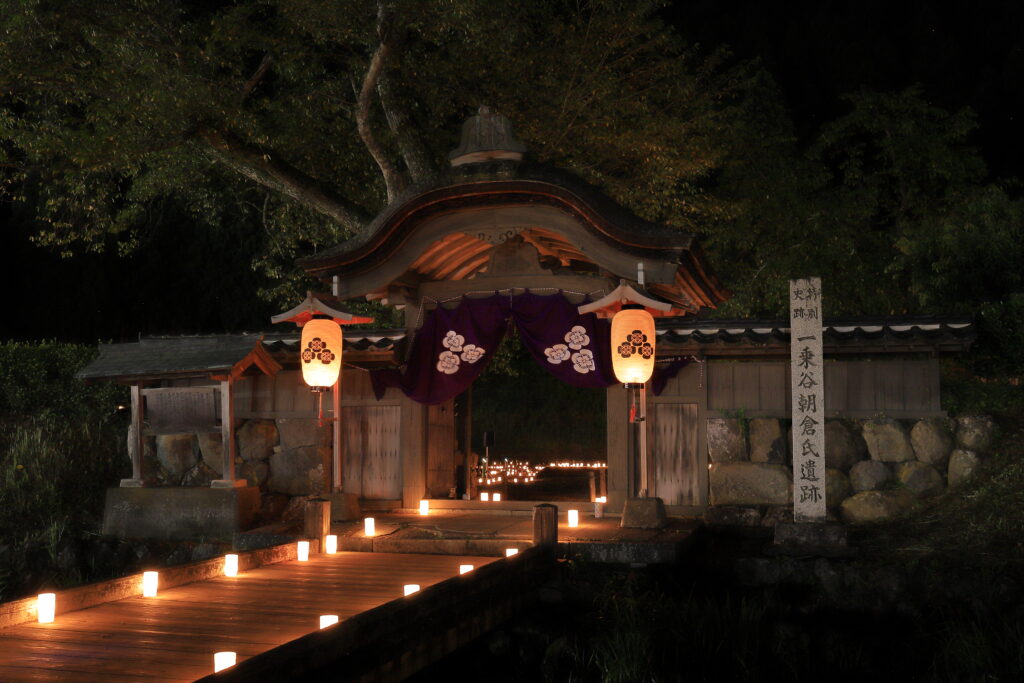
These are the remains of the castle town from which five generations of the Asakura clan ruled Echizen Province for 103 years. At its height some 10,000 people lived here, making it one of Japan’s richest cultural cities after Kyoto, Osaka and Sakai. In August 1573 the armies of Oda Nobunaga set it ablaze; the fires burned for three days and three nights, and the town was reduced to ashes.
Excavation began
1967 –
Samurai residences, temples and shrines, townhouses and streets have been reconstructed.
Only six places in all of Japan hold all three national designations at once. The other five — Kinkaku-ji, Ginkaku-ji, Sanbo-in at Daigo-ji, the Nara Palace Site and Itsukushima Shrine — are already inscribed as World Heritage sites.
Japan Heritage
Certified as part of “Tales Told in Stone: Fukui and Katsuyama”
In partnership with Hakusan Heisenji, the Fukui Castle ruins and other sites.
Establishment background
How and Why We Were Founded
For nearly four centuries Ichijodani lay buried, a “phantom capital.” As excavation gradually revealed the town in full, momentum grew for World Heritage inscription. Creative ASUWA was founded to help make that a reality and to revitalise the surrounding community.
The rise of the Asakura clan
Five generations of the Asakura clan built a castle town at Ichijodani in Echizen Province and ruled from it for 103 years. With a population of around 10,000, it flourished as a major centre of culture.
Oda Nobunaga burns the town
On 17 August, Nobunaga’s forces set the town alight. It burned for three days and three nights and was destroyed. Asakura Yoshikage took his own life, and Ichijodani slept beneath the soil for nearly 400 years.
Full-scale excavation begins
Samurai residences, temples and shrines, townhouses, artisan quarters and streets were reconstructed one after another. The site received all three national designations — Special Historic Site, Special Place of Scenic Beauty and Important Cultural Property — and was later certified as Japan Heritage.
Creative ASUWA is established
Founded to build momentum for World Heritage inscription and to revitalise the region. Based in the Asuwa district, we share the appeal of Ichijodani at home and abroad through events, tourism and cultural programmes.
Our activities
What We Do
We are building an inviting monzen-machi — a lively town at the gateway to the site — through both infrastructure and cultural programming. With World Heritage inscription as our anchor, we aim for sustainable growth in both community and tourism.
01
Creating a Lively Gateway
for World Heritage
We are giving the Ichijodani area the functions of a monzen-machi and shaping welcoming spaces for visitors, along with experiences that convey the value of the ruins.
02
Cultural Programming
Through wide-area partnerships we plan and run cultural events and hands-on programmes, including the Yokai Castle Town Project and the Asakura Kyogaku Project.
03
Community Partnerships
Working with local people on guesthouse development, tourism promotion and more, we pursue sustainable growth and the revitalisation of the whole Asuwa district.
04
Supporting Work
We take on whatever else supports the three areas above: public communication, archival research, and closer cooperation with government and partner organisations.
Organization
Organization Profile
| Name | Creative ASUWA (General Incorporated Association) |
|---|---|
| Purpose | To revitalise the region, with World Heritage inscription for the Ichijodani Asakura Family Historic Ruins as our anchor |
| Chairman | Kiyoshi Kishida (Former President, Asakura Clan Ruins Preservation Association) |
| Address | 9-8 Ikube-cho, Fukui City, Fukui 919-0314, Japan |
| Contact | Go to the contact form |
Get in touch